
Assessment and reporting has two aims, firstly to recognise students’ achievements and secondly to help identify and plan next steps in their learning.
To accomplish these aims, we regularly publish information and communicate in a range of ways. The most important meetings are those between students, parents and the tutor, at the Meet the Tutor evenings. Throughout the year the tutor discusses progress with the student and is the primary point of contact for parents. We also welcome any contact, at any time to teachers, Heads of Departments or Heads of Year.
A range of people, information and activities
are provided to help you and your child
plan the next steps in their learning, because
what we do each day makes a difference.
Targets
Each students is given a single target to help them achieve excellent results. These targets can be exceeded.
They are based on based on standardised assessments at Key Stage 2 and Key Stage 3
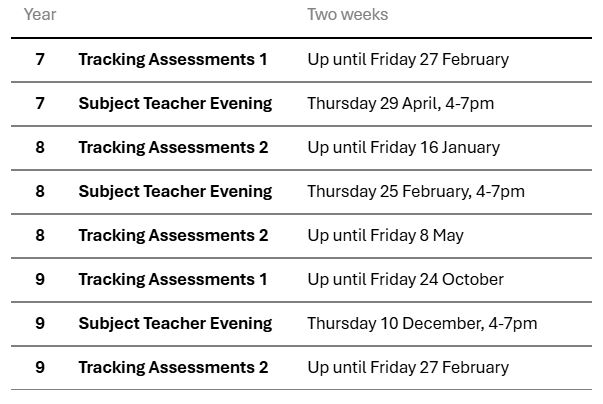
Tracking Assessments
-
These are usually twice a year
-
Uses comparable assessmentsacross most classes in mostsubjects
-
Provides a grade per subject tocompare to students’ target
-
Also approach to learning
-
Followed by Report or Report and Subject Teacher Meeting
Approach to Learning Matters
Tracking Assessments also recognise students' input into their leanring. This is recorded as one of four levels of approach to their classwork and homework.
| Exceptional | The student is fully prepared, committed and working to the best of their ability in every lesson. The student often volunteers constructive contributions to lessons. The student is fully focused, attentive and cooperative at all times, helping fellow students to learn and staff to teach. The student often uses their initiative and takes an active and appropriate part in all class activities. Homework is always completed on time to maximum ability. |
| Strong | The student always tries hard in lessons and follows instructions willingly and thoroughly. The student contributes to class discussions and is always ready to learn, including always having the correct books and equipment. The student has a very good level of focus, attention and cooperation in class. The student is extremely positive and helpful in lessons. Homework is always completed on time to a very good standard and is appropriate to their ability. |
| Expected | The student almost always tries hard in lessons and follows instructions willingly. The student contributes to class discussions and is always ready to learn, including almost always having the correct books and equipment. The student has a good level of focus, attention and cooperation in class. The student is positive and helpful in lessons. Homework is completed on time to a good standard appropriately to ability. |
| Needs Attention | The student usually engages in the lesson but sometimes needs reminding to keep on task and to give more effort. The student is usually willing and ready to learn but sometimes unprepared, e.g. forgetting books/equipment. The student’s behaviour is usually acceptable but sometimes behaviour can be disruptive, making it harder for students to learn and teachers to teach. Homework is usually completed but not always on time, with evidence of the work being rushed and not reaching the standard of which the student is capable. |
| Urgent Improvement Needed | The student makes little apparent effort and needs frequent reminders to stay on task. The student is often not willing or ready to learn, frequently forgetting books and equipment. The student regularly displays disruptive behaviour which prevents other students learning and the teacher teaching. Homework is rarely completed on time or to the standard of which the student is capable. |
Feedback in Books
Exercise books are an important record of students’ progress and also contain key vocabulary to learn, recognition of strengths, areas to develop and space to respond to feedback. These will often provide useful information at subject level to help plan specific actions.
End of Year and Mock Exams
To help assess progress made over the year and to help prepare students for their final exams at the end of their courses we hold formal end of year and mock examinations.
In maths, English and science for students in years 7, 8 and 9 these are held in the sports hall. Students in year 10 complete mock exams in almost all subjects in March, and year 11 complete mock exams in November.
As well as helping students develop confident routines for revision and exams; end of year exams provide information, alongside other assessments, to help review student groups and next steps for the following year.